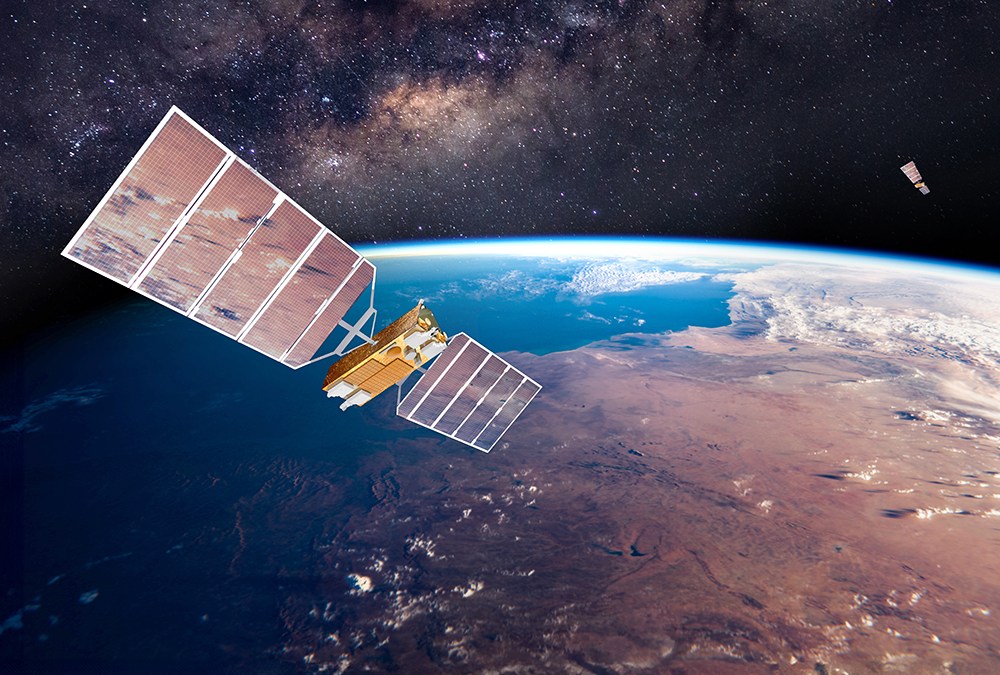
Transformative deep tech innovation is the key to unlocking value from the emerging space ecosystem – and there’s no doubt in my mind that the telecoms industry will play a pivotal role in this exciting future. But success in this new era will depend not only on technology leadership, but also on strong collaboration across the ecosystem. Leading the charge are NTNs (non-terrestrial networks), a sophisticated mix of ingenious innovation, complex platform hardware and increasingly strategic industry partnerships.
Set to extend 5G and 6G mobile connectivity to the most extreme corners of earth, NTNs are enabled by a host of innovations that include advanced antennas, beamforming, signal processing, novel computational architectures and much more. Increasingly, these technologies are also enabling direct-to-device (D2D) connectivity, allowing standard smartphones and IoT devices to connect seamlessly via satellite without specialised hardware. This creates a major opportunity for telecom operators to extend coverage, strengthen network resilience and unlock new service models in underserved and remote regions – but delivering these capabilities at scale will require close cooperation between telecom operators, satellite providers and technology vendors.
Unsurprisingly, AI will also play an increasingly important role in the evolution of not just NTNs, but mobile connectivity in general. I believe these technologies will start to influence not just NTNs, but much of everything else that’s happening in the space economy from a communications perspective.
Telecoms and satellite make for the perfect marriage
Telecom business leaders should be optimistic about how the future will play out, but need to be mindful of the need for collaboration. The road ahead is as complex as it is commercially promising – and no one can hope to navigate the journey alone. It’s also vital for the industry to play a leading and influential role in defining the standards that will shape the NTN ecosystem. Integral to this is the imperative for interoperability and system integration, particularly as satellite connectivity becomes more tightly integrated with terrestrial mobile networks and consumer devices.
For me, the current situation can be seen as the perfect marriage, the coming together of the mobile telecom and satellite industries. Satellite is smaller in comparison, perhaps giving mobile telecoms the upper hand in terms of influence, but satellite brings unfamiliar challenges to mobile operators. At the same time, it offers operators a compelling opportunity to close coverage gaps, provide dependable backup connectivity during outages and support critical communications during disaster recovery scenarios. The standardisation I’ve mentioned marks a change for the satellite industry, where proprietary standards and technology choices have previously prevailed.
That shift makes close collaboration between Satellite Network Operators (SNOs) and Mobile Network Operators (MNOs) increasingly important. To realise the vision of ubiquitous connectivity, the industry must work together to optimise the air interface and network layers, manage performance challenges and ensure system-wide interoperability. The ability to seamlessly converge terrestrial and non-terrestrial connectivity will play a defining role in shaping the capabilities and commercial models of the 6G era, forming part of the foundation for the next generation of critical communications infrastructure.
In a standards-led future, new ways will be needed to differentiate and innovate within a standard framework – and a go-it-alone strategy won’t be viable. Strong strategic partnerships across telecoms, satellite, infrastructure and device ecosystems will be vital to accelerating deployment and ensuring interoperability at scale.
The deep tech innovations shaping the new space economy
From that perspective, let me explore the potential of telecom innovation in a little more detail. NTNs are essentially any network that’s not on the ground. They can be characterised as an amalgam of industries, technologies, standards and regulations that are converging from ground-based cellular networks and satellite systems. As competition hots up in space, successful players will form partnerships of satellite providers, HAP (high altitude platform) providers, terrestrial network operators and technology vendors.
And we’re not just talking about ‘cell towers in space’ – we’re envisaging space-based data centres and distributed network infrastructure that will connect the world faster and more sustainably than ever. These developments will also support more resilient global connectivity architectures, where satellite can complement terrestrial infrastructure and help maintain service continuity in hard-to-reach or disrupted environments. There are naturally challenges to powering and cooling data centres in space, a new paradigm that I think is only a decade or so away. But processing data on-orbit and the reduction in data transmitted to the ground will reduce the power requirements of systems overall. Putting the hardware up there doesn’t sound immediately sustainable, but the long-term benefits will more than compensate.
Another breakthrough technology is free space optical communication (FSOC). This transformative approach to data transmission leverages light propagation through free space to deliver unparalleled high-bandwidth and low-latency communications. FSOC can transmit data over longer distances and higher speeds for both increased range and capacity, with much better resilience for interference-free operation. As these technologies mature, collaboration across the wider communications ecosystem will be essential to integrate them into scalable commercial networks.
I also want to highlight the progress towards space data centers in the field of optical data processing with photonics integrated circuits (PICs). As the demand for data processing grows, so does the need for advanced computing solutions. Photonic computing is an ingenious solution, offering better sustainability with low-latency compute. Through the power of light, photonics has transformative potential for future compute.
There’s also great importance in advanced antenna technologies and beamforming, including phased-array antennas and smart antennas. More than ever, they are regarded as the lynchpin for optimizing NTN performance, signal quality and coverage, and they’ll play an increasingly influential role in the wider space economy. As D2D services mature, these technologies will also be essential in enabling seamless connectivity between satellites and everyday consumer devices at scale – something that will rely heavily on alignment between operators, device manufacturers and infrastructure partners.
In a stratospheric HAPS application, the world’s largest commercial airborne antenna can provide widescale coverage of 5G at a fraction of the cost of terrestrial networks. Its beamforming elements deliver finely targeted coverage from an altitude of 20,000 meters, yet the antenna is light enough to be carried by extremely lightweight zero-emission aircraft.
Such ingenuity can be applied down on the ground too. It’s important for innovators to not just focus on the space segment of the new ecosystem. Development of user terminals back on earth, for example, offers the opportunity for differentiation and competitive advantage through novel handsets – maybe featuring transparent antennas. Over time, we can also expect closer integration between terrestrial and satellite connectivity in mainstream devices, helping operators deliver more ubiquitous and resilient services to consumers and enterprises alike.
Winning the space race
Ultimately, space presents a new frontier of commercial opportunity. The big winners will be those who collaborate successfully, forge strategic partnerships and shape the standards and regulations that will deliver interoperability and successful system integration. For telecom operators in particular, satellite-enabled D2D services represent an opportunity not only to extend coverage, but also to differentiate customer experience and create new revenue streams.
But there isn’t enough space for everyone. Those that build the strongest ecosystems, partnerships and standards influence will be best positioned to lead the next era of satellite connectivity.
Reach out to continue the conversation and become a part of the new era of satellite connectivity.
Expert authors

Stewart Marsh
Stewart helps companies achieve technology breakthroughs that unlock transformative business value, including a world-first Push-to-Talk satellite service and a beyond visual line-of-sight UAV solution using low power satellite technology.