
Telecoms, energy and grid, digital infrastructure and transportation are four of the world’s most critical infrastructure sectors. Each is changing radically; but it is the once-in-a-generation convergence of these transformations that is unleashing not just incremental progress – but the creation of entirely new categories of human and industrial capability. This convergence is a strategic inflection point for infrastructure leaders. Exponential value awaits the organizations that act decisively to capture this competitive advantage.
The transformations of the sectors are not four separate stories. They represent a single narrative of critical infrastructure evolving from siloed systems into an integrated, AI-powered system for enhanced performance, resilience, and entirely new sources of commercial value.
Those who recognize this convergence early, build strategies that span the interfaces, and partner with teams that have genuine technical depth across all four domains will define the next era of global infrastructure.
The window for strategic differentiation is open now – and the imperative is to move from thinking in silos to systems thinking. Our article guides you through this changing mindset as we unpack the four transformations, reveal the potency of their convergence and share a four-point plan of strategic priorities for CEOs operating in the infrastructure sectors and owning infrastructure assets.
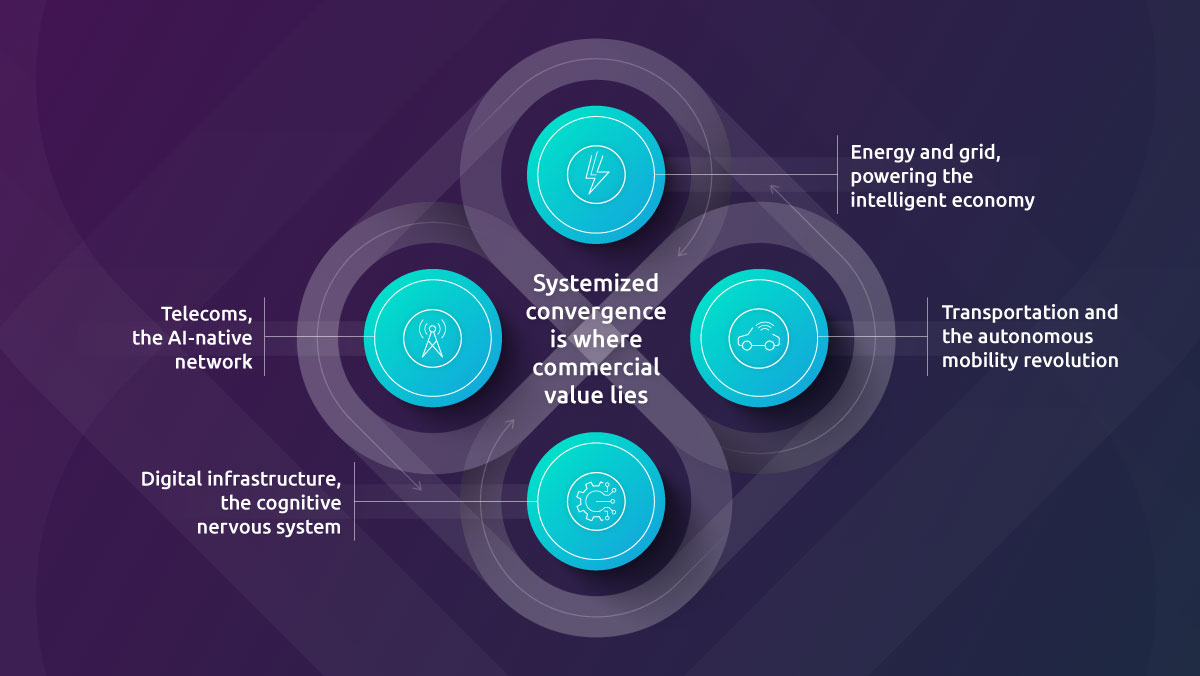
It’s important to stress that the convergence allows business leaders to capture value at the points that the systems intersect. Siloed thinking becomes redundant, with the new integrated model enabling entirely new categories such as autonomous mobility services, grid-flexibility marketplaces, AI-enabled infrastructure services and immersive low-latency experiences. These intersection points will concentrate disproportionate economic value. Structural cost and performance advantages will follow, as optimization across interfaces reduces latency, energy costs and inefficiencies.
There will be clear winners and losers here. Companies that orchestrate across sectors will access entirely new market opportunities and become platform owners, capturing disproportionate value over the siloed players relegated to commoditized roles.
Four transformations, one systemized shift
The four sector transformations are not coincidentally occurring at the same time. They are structurally interdependent in ways that create both compounding risks and compounding opportunities. We’ll explore this in a moment, but to set the scene let’s walk through the sectors, starting with telecommunications, which is undergoing its most fundamental architectural change since the shift to mobile.
Telecoms, the AI-native network
The traditional model of purpose-built hardware running proprietary software in fixed locations is being replaced by software-defined, cloud-native architectures. AI-native networks will self-configure, self-heal, and self-optimize, enabling zero-touch operations and intent-driven service delivery. The integration of non-terrestrial networks (NTNs) will extend connectivity to every point on the planet, while private networks will unlock a new class of enterprise applications.
In addition, the telecom infrastructure is becoming a conduit for AI at the edge. The data center/compute infrastructure expands and rides on the existing physical telco network to deliver GPUs and real-time inferencing at the edge – closer to where the real-world applications happen.
The paradigm shift is from ‘networks that carry traffic’ to ‘networks that think and physically shape-shift to meet demands’. The autonomous network will both enable and embody advanced physical AI – making real-time decisions, anticipating and pre-empting outages, re-structuring itself for mission, and engaging users with differentiated, monetizable experiences.
Energy and grid, powering the intelligent economy
Energy infrastructure is confronting an unprecedented demand shock. After decades of near-flat electricity consumption in developed economies, the convergence of AI-driven data center growth, electric vehicle fleet electrification and industrial reshoring is driving record load growth.
Meeting this demand requires a transformation of the grid itself:
- Smart grids – integrating advanced metering, distributed energy resources, bidirectional power flows and AI-driven optimization – are replacing centralized, one-way power delivery
- Renewable generation from solar and wind, which requires sophisticated forecasting and real-time balancing
- Distributed storage and demand-response systems are turning large energy consumers, including data centers, into grid stabilizers rather than passive loads
- Nuclear small modular reactors (SMRs) are beginning to offer a path to reliable, low-carbon baseload power at scales suited to collocated digital infrastructure
The opportunity for CEOs is to find ways to architect an intelligent, decarbonized energy system that can support an AI economy – and monetize grid flexibility as a new revenue stream in a timeline that is economically viable and technically feasible, while actively managing resilience, cost, and regulatory exposure.
The paradigm shift is from ‘networks that carry traffic’ to ‘networks that think and physically shape-shift to meet demands’. The autonomous network will both enable and embody advanced physical AI – making real-time decisions, anticipating and pre-empting outages, re-structuring itself for mission, and engaging users with differentiated, monetizable experiences.
Digital infrastructure, the cognitive nervous system
Data centers are no longer server-warehouse cost centers. Hyperscale facilities are now strategic infrastructure, vital to national competitiveness.
The compute architecture is also evolving rapidly. The distinction between hyperscale (training and large inference workloads), edge (real-time, low-latency applications) and sovereign (data sovereignty and security requirements) tiers is crystalizing. The question of where computation happens – from the hyperscaler campus to the network edge to the device itself – is becoming a fundamental design and capital allocation decision for every major enterprise and government.
Transportation and the autonomous mobility revolution
Transportation is transitioning from a system of siloed, human-operated conveyances to an integrated, intelligent mobility ecosystem. Autonomous vehicles are moving from controlled pilots to commercial deployment as Waymo, Aurora Innovation, Waabi and others demonstrate that driverless operations are viable at scale.
The transformation extends far beyond passenger cars to everything from autonomous freight, urban air mobility, vehicle-to-everything communication and beyond. The dependency on telecommunications and digital infrastructure is non-negotiable. A fully autonomous vehicle is a mobile data center, processing sensor fusion data, receiving real-time map updates and participating in a networked traffic management system.
The road to autonomous mobility runs through all four transformations simultaneously forcing nations and corporations to consider their approach to digitalization of infrastructure. Cross-sector alignment is now a strategic necessity.
Why the convergence is interconnected
As we’ve already said, the structural interdependence of the critical infrastructures creates both risks and opportunities. Look at it this way. Autonomous mobility demands ultra-low-latency connectivity. That requires exponentially more compute. That demands unprecedented power. And that power must be clean, resilient and intelligently managed. The sectors are becoming a system… and if you understand it, you’ll capture the value that’ll be missed by those who see only silos.
This fundamental, systemic interdependency leads to the central takeaway of our article: when these technologies converge, they unlock commercially viable experiences and services that were previously impossible. Personalized, immersive, connected, AI‑mediated interactions delivered anywhere. It could be a surgeon performing a remote procedure over a private 5G network, a logistics system dynamically rerouting autonomous freight in real time, or a citizen in an unserved community accessing services via non‑terrestrial connectivity. These are outcomes that only the system can deliver, not any single sector.
So, here’s the big question. If you are CEO in these sectors, how do you grasp the value of this transformative convergence? How do you rise to the urgency of the challenge and harness this most compelling strategic opportunity? We propose the following four-point plan or prioritization.
1. Think in systems, not sectors
The most consequential competitive advantage available to infrastructure leaders is cross-sector understanding. Telecoms executives must understand energy constraints; energy executives must model data center load dynamics; datacenter operators must anticipate autonomous vehicle connectivity demands. Strategy teams that remain siloed by sector will consistently mis-price risk and mis-allocate capital.
2. Build AI-native architecture from the start
Retrofitting AI into legacy infrastructure – whether a fixed-line network, a conventional grid, a traditional data center or a highway management system is both expensive and structurally limited. The organizations capturing disproportionate value are those that are designing AI-native architectures. Networks that self-optimize, grids that respond in real time, compute platforms that flex between training and inference workloads and transport systems where AI is the core control plane, not an add-on.
3. Address the energy-compute bottleneck
The single most acute constraint on the deployment of AI infrastructure is not algorithms, not capital, and not talent – it is power. Organizations that act now to secure clean, reliable power through power purchase agreements, co-location with renewables, small modular reactor partnerships or demand-response capability, will have a structural advantage. Energy strategy is now inseparable from AI, infrastructure, and growth strategy.
4. Govern through the transition, not just the destination
All four transformations involve regulated industries, complex safety requirements, and significant public interest considerations. Regulatory frameworks will evolve – in some jurisdictions already rapidly, in others not yet at all. The organizations that will avoid costly delays are those that engage proactively with regulators, invest in AI assurance and safety frameworks, and help shape the standards that will define the competitive environment for the next decade. Regulatory engagement is now a source of durable competitive advantage.
The time to act is now
The golden thread running through all our advice is to act early to seize significant first-mover advantage.
Decisions made now will lock in ten plus years of competitive positions. Early movers will secure access; late movers face constrained growth. Note too that convergence is accelerating, with autonomous systems, AI workloads and electrification already scaling. Organizations that wait for maturity will enter a market where ecosystems and standards are already defined by others. The window for leadership is limited and closing faster than most organizations expect.
お問い合わせ
Do please reach out to us if this topic strikes a chord with your ambitions. With deep tech expertise across developing AI-native systems and end-to-end system design across hardware, software and infrastructure at global scale, our teams are well placed to help. Few organizations combine this level of cross-domain engineering depth with the ability to translate strategy into deployed systems at scale.
And a final word: we love a challenge. Value here lies in solving problems without standard solutions – so deep technical invention, not benchmarking, is the order of the day. Highly complex, first-of-a-kind challenges are what drive us, and this convergence is a perfect example. If you’re intent on accelerating your journey from strategy to sustained commercial advantage, let’s talk.
専門家

アーシュ・ヴィルマニ
複雑な事象をシンプルにし、アイデアのビジネス価値を言語化することに情熱を注ぐ専門家。20年以上にわたり、事業開発、M&A、プロダクト戦略を牽引してきたエグゼクティブ。データサイエンスのバックグラウンドを持ち、通信分野で20年以上、フィンテック領域で6年間の経験を積んだプロフェッショナル。

Christoph Domke
Christoph Domke is a strategy leader with 17+ years of global experience across robotics, autonomous systems, mobility, and next-generation logistics. He focuses on how AI-driven, software-defined technologies are transforming supply chains, transportation, and industrial operations.

コリン キャンベル
米国ボストンに拠点を置き、テクノロジー部門の責任者として豊富な経験を有する。お客様のビジネスニーズを満たす技術革新を生み出すべく、卓越した技術とサポートを提供。技術者として、デジタル技術 (無線通信、AI/ ML、エッジコンピューティング)の進化を常に探求し、新しいアプリケーションにおいてこれらの進化を活用し、事業機会の拡大に従事している。

ニール モトラム
Niall leads business development in our Energy and Industrial group, focusing on identifying new opportunities for ambitious companies through the leverage of emerging technologies and implementation of new business processes.

Dr Sinan Yordem
Sinan grows and develops businesses through the power of innovation. With more than 15 years’ experience of leading start-up and corporate growth initiatives, he’s delivered breakthrough physical products and digital services to government and industry clients across the world.