R&D teams across industries are operating under unprecedented pressure. Markets demand faster innovation cycles, superior product performance and greater efficiency from R&D investment – all while managing geopolitical uncertainty and maintaining uncompromising standards of quality, safety and real-world reliability.
Many organisations have turned to ambitious digital first programmes to fill this gap, but their impact remains limited. Too often, digital and AI-led initiatives are layered onto legacy laboratory environments without addressing the underlying physical systems and workflows that generate the data.
Instead, we believe the answer lies in a complete rethink of the structure of innovation itself: hybrid labs.
The widening gap between R&D ambition and delivery
Most organisations continue to operate with legacy R&D systems designed for a different era centred around manual processes, sequential workflows and fragmented digital tooling. Experimental workflows remain fundamentally linear: design, test, analyse, repeat. Data is generated in high volumes but remains siloed, inconsistent in structure and difficult to extract, integrate or reuse. In many environments, scientists spend the majority of their time – often over half their time – finding, cleaning and preparing data rather than generating insight.
Incremental progress to modernise these traditional labs has seen digital transformation and AI layered onto heritage foundations rather than integrated into them. All too often, these initiatives are introduced without being co-designed with the scientists who use them, creating parallel physical and digital ecosystems that do not reinforce one another, creating fragmentation rather than acceleration.
The result? A growing structural mismatch between innovation ambition and the system’s ability to deliver it. Scientists are becoming busier, but not more effective, with R&D effort increasing faster than R&D impact.
As organisations set increasingly ambitious targets for faster, digital-first innovation, hybrid labs offer the step change needed in how physical experimentation, data, automation and AI work together.
How hybrid labs shift R&D from fragmented experimentation to holistic, human-centred innovation systems
Hybrid labs address this mismatch by rethinking how physical experimentation, data, automation and AI operate together as a single system.
A hybrid lab – sometimes referred to as “lab-in-the-loop” – is a holistic R&D approach that fuses physical experimentation, digital intelligence and human decision-making into a single continuously learning environment. In this environment, laboratory execution, instrumentation, data architecture, simulation and AI are not separate layers but orchestrated components of one system where each experiment informs the next.
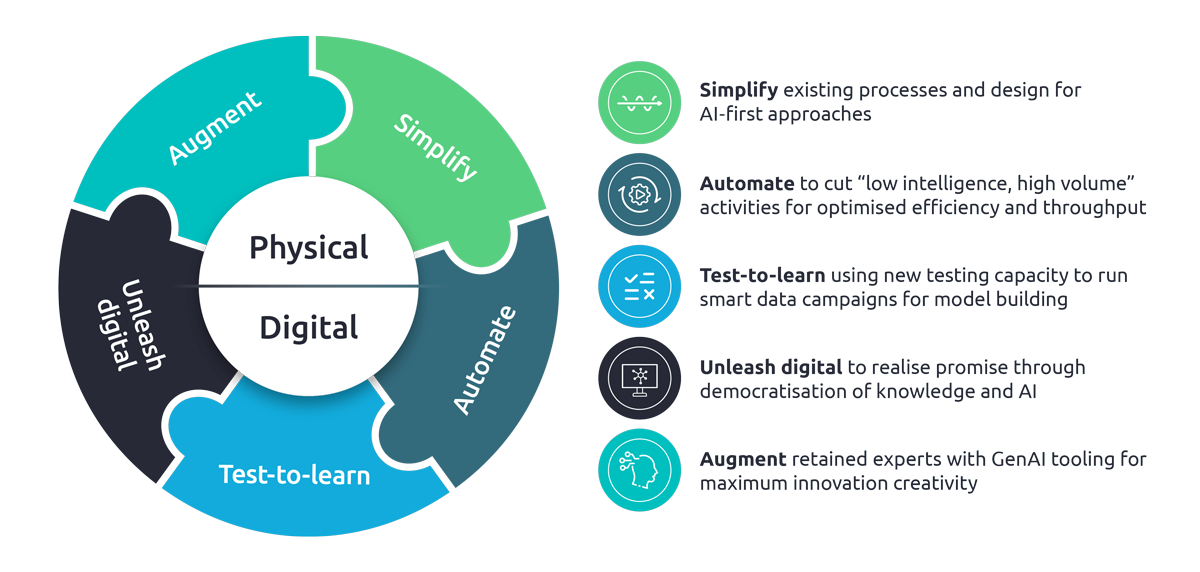
Critically, this is not about starting with AI. Effective hybrid lab transformation follows a clear sequence: simplifying workflows, removing low-value manual activity and strengthening physical and data foundations first. Only then can automation, digital tools and AI scale effectively. Without this, AI risks amplifying inefficiencies rather than resolving them.
Hybrid labs approach to reimagine R&D
In practice, this shift moves R&D towards predictive, model-led development, improving decision quality at the earliest point in the innovation cycle – where experimental direction, system architectures and development pathways are defined.
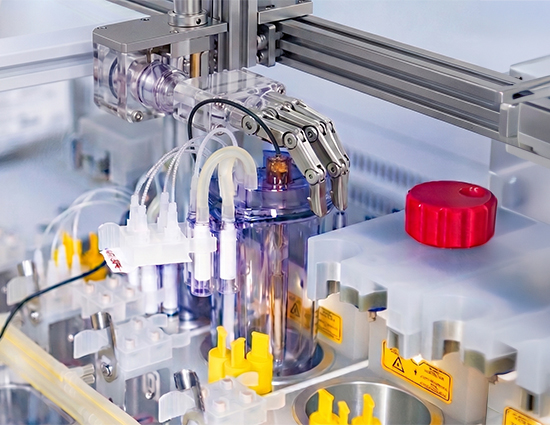
Experiments are designed digitally, executed physically through connected and increasingly automated systems, and captured as structured, contextual data at source. AI models then interpret results, identify patterns and guide subsequent experimentation. Alongside this, emerging agentic AI capabilities extend what automation and models can do, coordinating multiple reasoning pathways to support scientific decision-making.
For example, agents can synthesise prior literature to establish existing knowledge in a domain, or evaluate formulations against regulatory constraints and ingredient interactions. These capabilities act as structured support within the loop, helping scientists navigate complexity while keeping final decisions grounded in experimental reality.
Vitally, these systems are designed with people at their core. This approach does not reduce the role of scientists – instead, it changes the structure of R&D. Hybrid labs remove the burden of fragmented data handling, manual processes and disconnected workflows from scientists, enabling them to focus on higher-value work: designing better experiments, interpreting complex results and solving cross-domain challenges.
As routine experimental orchestration and data handling becomes systematised, scientific value shifts toward hypothesis design, experimental framing and cross-domain interpretation. In effect, hybrid labs move human expertise upstream in the innovation cycle, where decisions have the greatest leverage.
In other words, a hybrid lab combines the expertise of scientists and engineers with modern experimentation within one orchestrated environment – not replacing human expertise, but augmenting and amplifying it, granting scientists the space and time to harness their creativity and deliver greater real-world impact.
By removing friction between experimentation, analysis and decision-making, development cycles are compressed from years to months. At the same time, the cost of innovation is reduced through better upstream decisions that minimise wasted experimentation. AI-guided experimentation increases hit rates and reduces late-stage failure, shifting organisations from “test-to-validate” to “test-to-learn” models where each experiment actively informs and refines the next, and datasets are generated specifically model development and digital-first outcomes.
In pharmaceuticals, this enables earlier de-risking of molecules and processes through tighter integration of biological science, automation and predictive modelling. In consumer industries, it enables closer alignment between market signals and product development, from trend-to-formulation pipelines through to predictive, demand-led innovation. Across all industries, hybrid labs enable faster, more reliable innovation at scale with a clearer path from technical possibility to commercial reality in a safety- and regulatory-ready manner.
The future of innovation is hybrid
The future of R&D is possible today, with hybrid labs acting as foundations for sustainable innovation, competitive advantage and long-term growth.
Global leaders are already beginning to move in this direction, combining automation, data and AI into unified, hybrid environments. Organisations such as Unilever や L’Oreal are investing heavily in next-generation facilities, technology providers like Microsoft are building R&D-focused platforms, while transformation partners such as Capgemini are helping scale adoption across enterprises.
As the deep tech powerhouse of Capgemini, CC is already applying this approach in practice. Our AI-native engineering biology lab – a lab-in-the-loop system for protein engineering – integrates experimentation, data generation and AI-driven optimisation into a continuous, self-improving cycle. Scientists, AI engineers, laboratory systems and digital infrastructure operate as one connected environment, enabling more effective use of data and faster, higher-quality decision-making.
The impact is tangible. Through this approach, we have significantly accelerated the design-build-test-learn (DBTL) cycle, developing improved protein variants with world-first performance using just 32 related proteins, compared to more than 10,000 required through conventional methods.
This “case zero” demonstrates what is possible when physical and digital systems are engineered together from the outset – delivering faster, more efficient and more reliable innovation outcomes.
Whether you are at the start and need help to identify the opportunities or in the depths of implementing AI, we can help you define your strategy, design the system and deliver an end‑to‑end hybrid lab approach – with human-centred intelligence embedded at the core to drive lasting success.
Reach out to continue the conversation around hybrid labs and visit our labs to discover how we can help out-pace your competitors.